
From Earth, moons can look like quiet dots. Up close, the category gets wonderfully unruly: one world is threaded with active volcanoes, another may hide a global ocean, and another has lakes filled with liquid methane. These are not miniature copies of our Moon; each is a distinct world with its own geology, chemistry, and history.
This is an editorial sampler, not a scientific ranking. We chose exactly ten moons for a different, well-documented physical oddity apiece, grouped by host planet from Jupiter to Neptune—not ranked for merit. The numbered order is not a best-to-worst score. Images below come from spacecraft observations; their captions flag mosaics, filter combinations, and false color where relevant. If you enjoy natural marvels closer to home, see our guide to natural phenomena that look unreal.
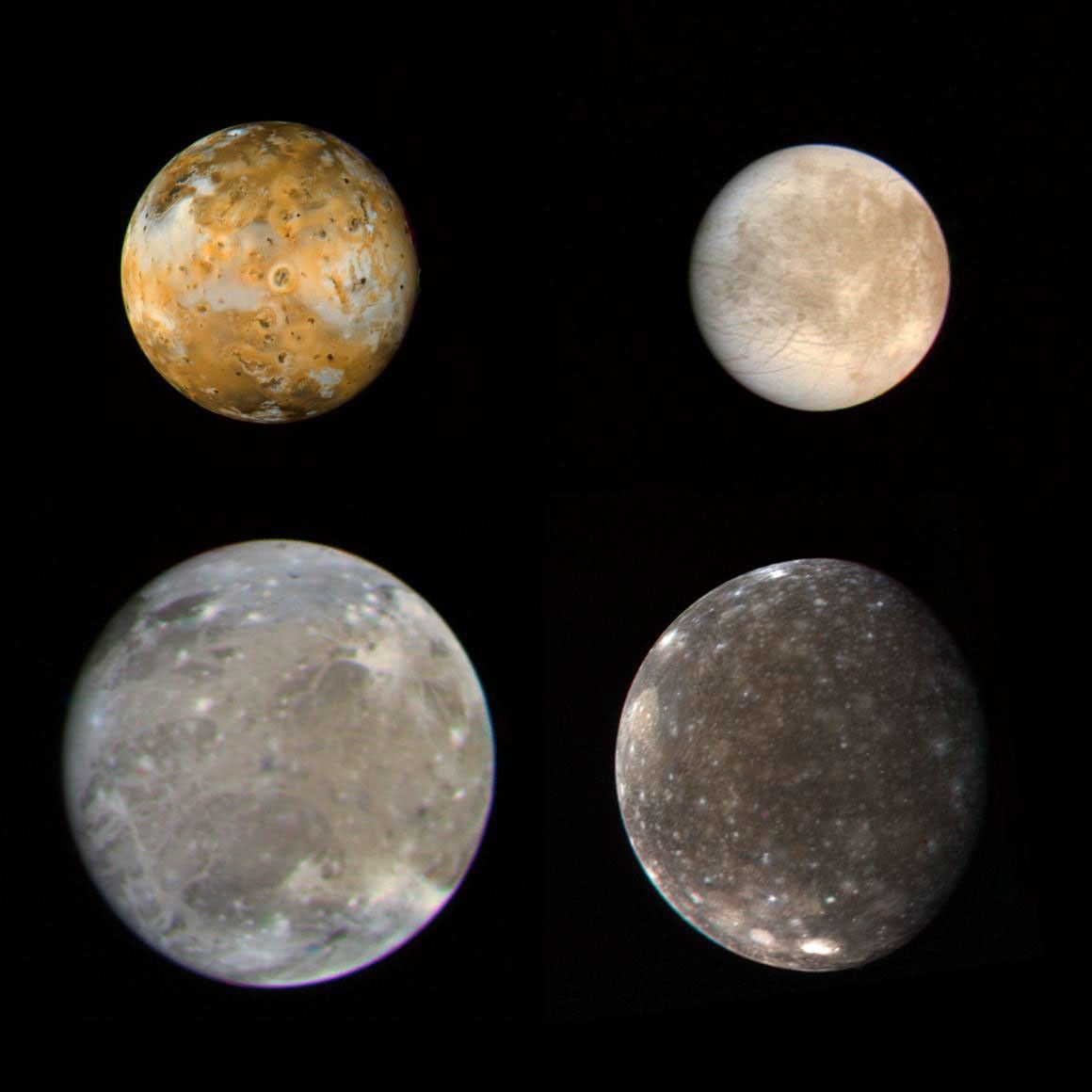
A Voyager 1 composite of Io, Europa, Ganymede, and Callisto, shown at the same scale so their relative sizes are clear. Credit: NASA/JPL. Image record.
1. Io: volcanoes that never seem to rest
NASA describes Io as the most volcanically active world known in the Solar System, with hundreds of volcanoes and lava fountains that can rise dozens of miles high. The power source is gravitational tug-of-war. Io’s slightly stretched orbit is repeatedly flexed by Jupiter and by neighboring Europa and Ganymede; the kneading warms its interior and helps drive the eruptions. That makes Io a striking reminder that a moon can be geologically restless rather than frozen in time.
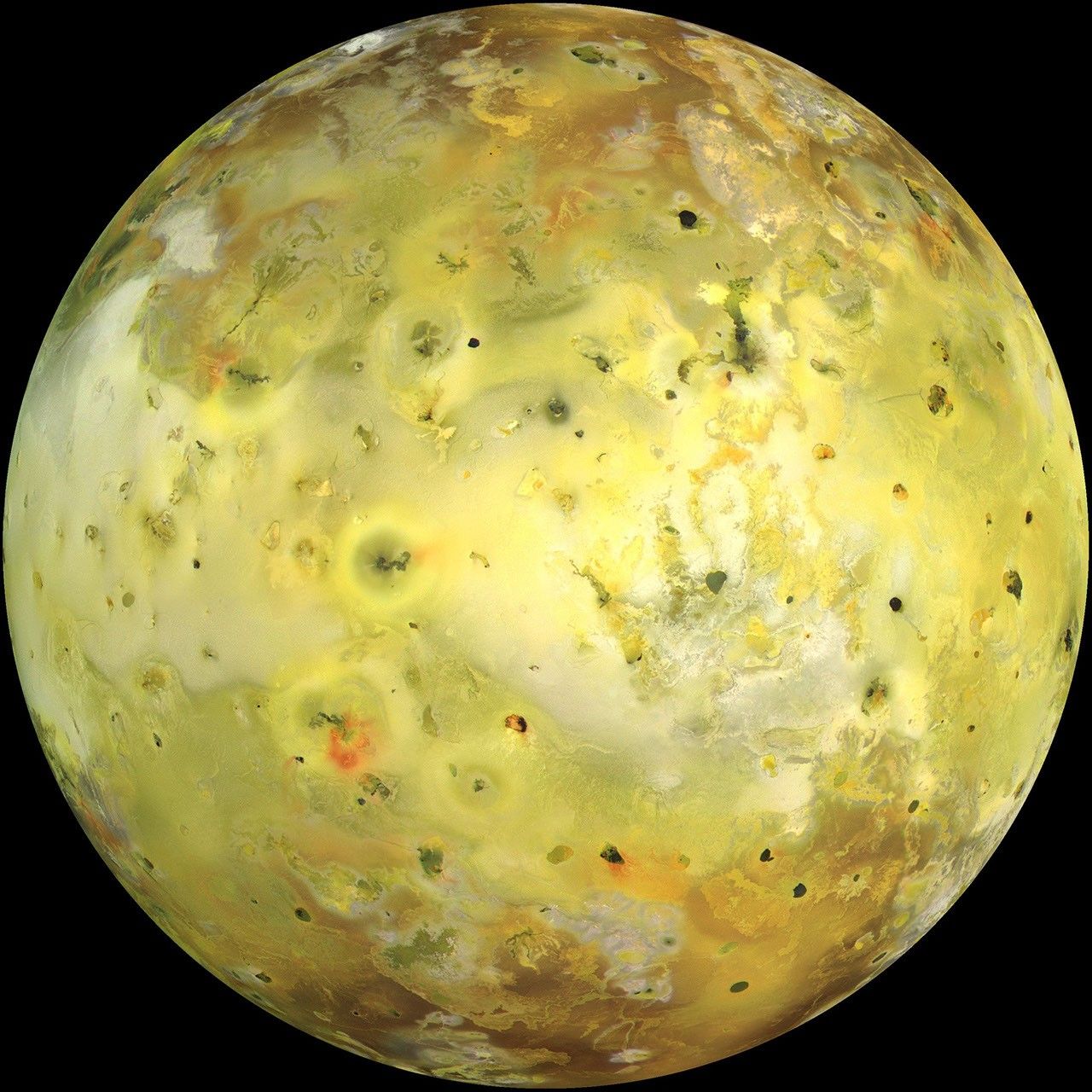
Galileo’s global mosaic uses near-infrared, green, and violet filters to approximate how Io might look to the eye; it is not a simple visible-light snapshot. Credit: NASA/JPL/University of Arizona. Image record.
2. Europa: a cracked shell over a likely ocean
Europa’s bright, icy surface is crosshatched with long fractures, but the bigger mystery is underneath. Measurements described in NASA’s Europa overview strongly suggest a conductive liquid layer below the ice; scientists think the most likely explanation is a global ocean of salty water. The evidence is strong, though its presence has not yet been confirmed directly. The surface also appears geologically young—NASA estimates roughly 40 to 90 million years—so Europa’s cracks and ridges may be clues to a world still shaped by heat and tidal flexing.
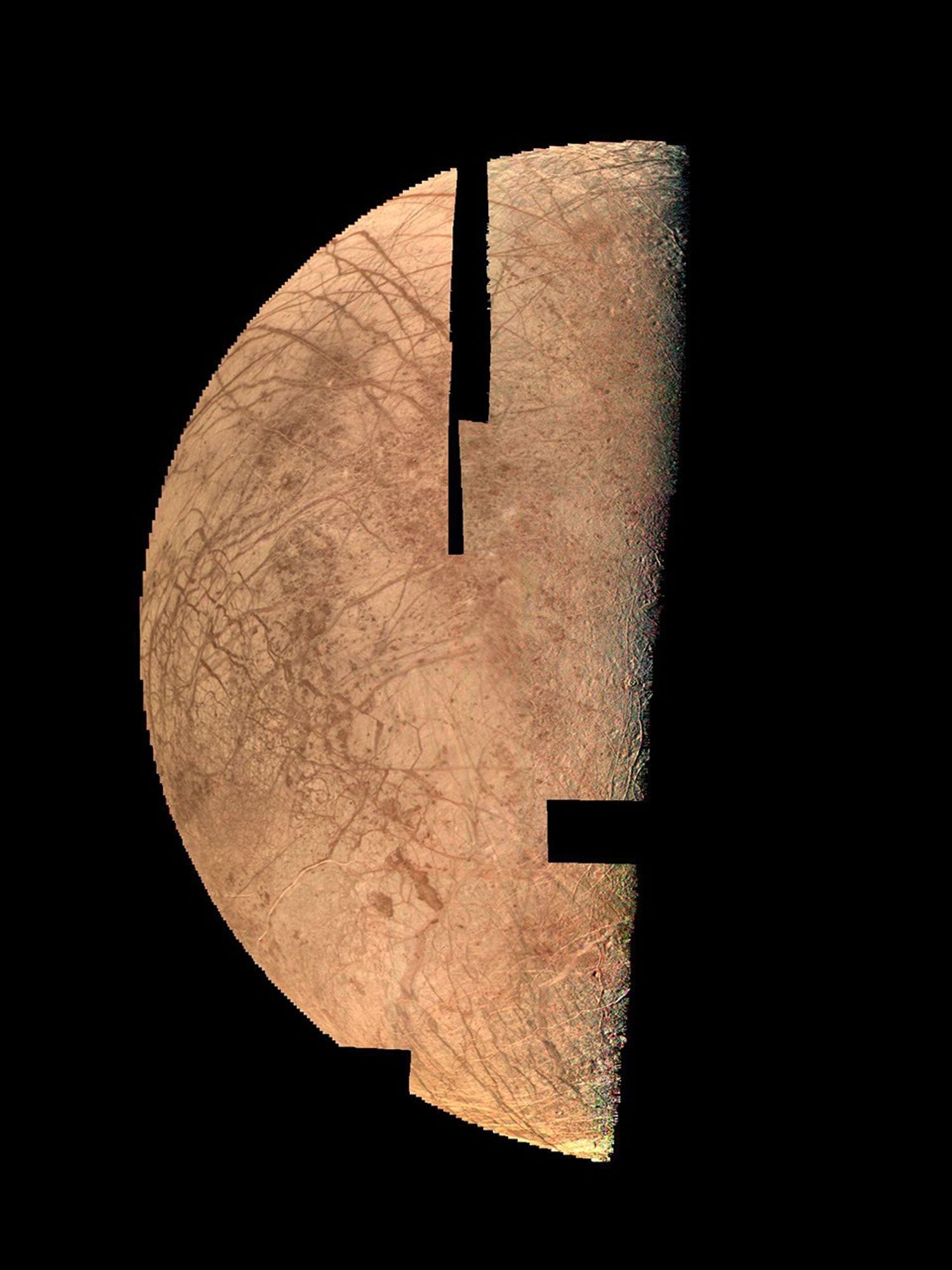
Voyager 2 images assembled into a computer mosaic; processing removes brightness changes caused by illumination so the surface markings show more evenly. Credit: NASA/JPL. Image record.
3. Ganymede: a moon with its own magnetic field
NASA’s Ganymede facts page identifies Ganymede as the largest moon in the Solar System—bigger than Mercury—and the only moon known to generate its own magnetic field. That field makes it a little world with a magnetic environment of its own, embedded inside Jupiter’s much larger one. The Hubble Space Telescope has also found evidence for a buried saltwater ocean. Its visible surface, meanwhile, mixes older dark terrain with brighter grooves and ridges, a record of geological change beneath the ice.
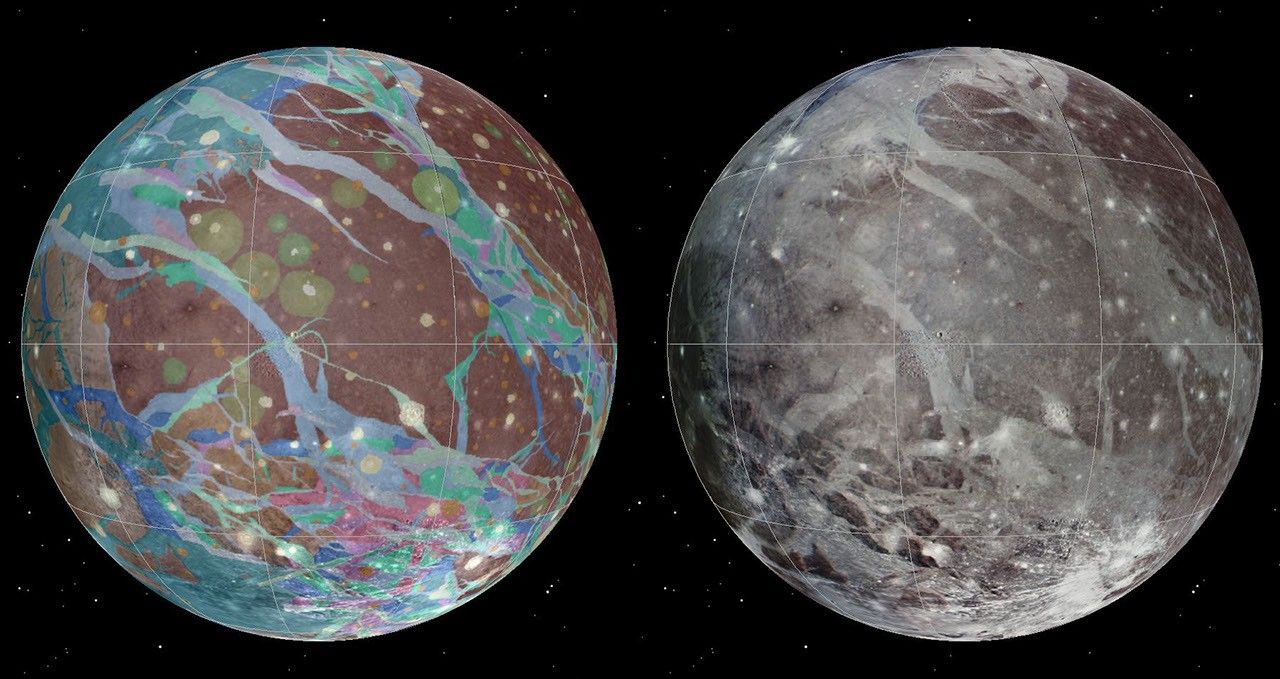
The image panel is a global mosaic assembled from Voyager and Galileo observations; the companion panel is a geologic map, not a photograph. Credit: USGS Astrogeology Science Center/Wheaton/NASA/JPL-Caltech. Image record.
4. Callisto: an ancient surface that keeps its scars
Callisto looks less active than its neighbors, and that is precisely its distinction. NASA estimates its ice-and-rock surface is about four billion years old and among the most heavily cratered known. With little evidence of volcanism or tectonic resurfacing to erase the marks, impact basins and bright young craters preserve a long record of collisions from the early Solar System. It is less a smooth moon than a geological archive whose oldest pages are still visible.
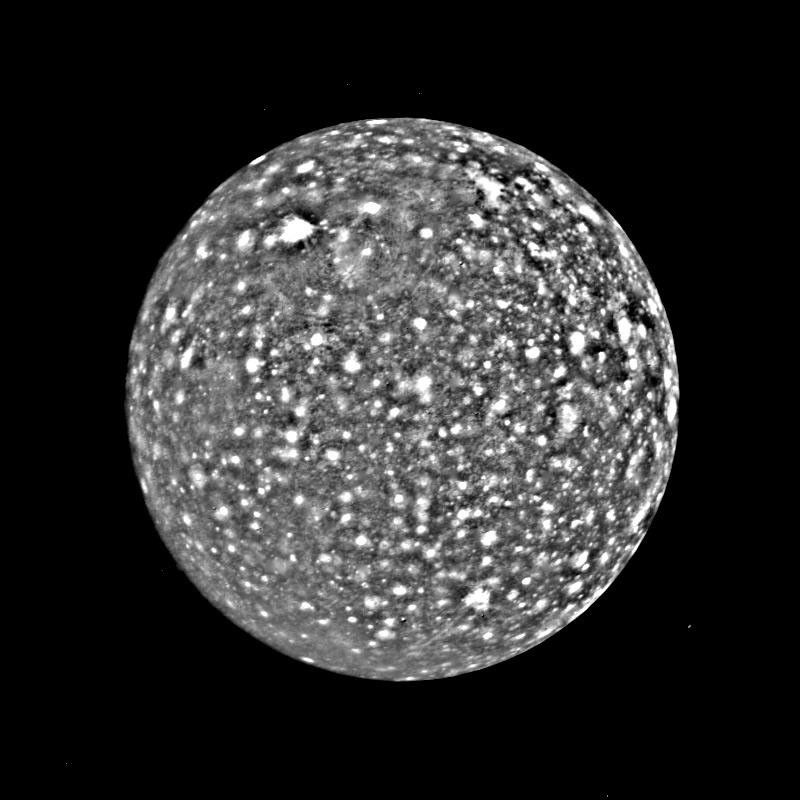
Voyager 2’s black-and-white image was enhanced to reveal detail; brighter spots are thought to expose fresh ice in younger craters. Credit: NASA/JPL. Image record.
5. Titan: a methane weather cycle
Titan’s atmosphere and liquid cycle make it the only moon known to have a substantial atmosphere, and the only place besides Earth known to have standing liquids on its surface. The twist is the chemistry: in Titan’s frigid climate, rivers, rain, lakes, and seas involve methane and ethane rather than water. Beneath its orange haze, the landscape has a cycle of clouds, rainfall, channels, and lakes. Titan may also hide a liquid-water ocean far below its icy crust, but scientists have found no evidence of life there.
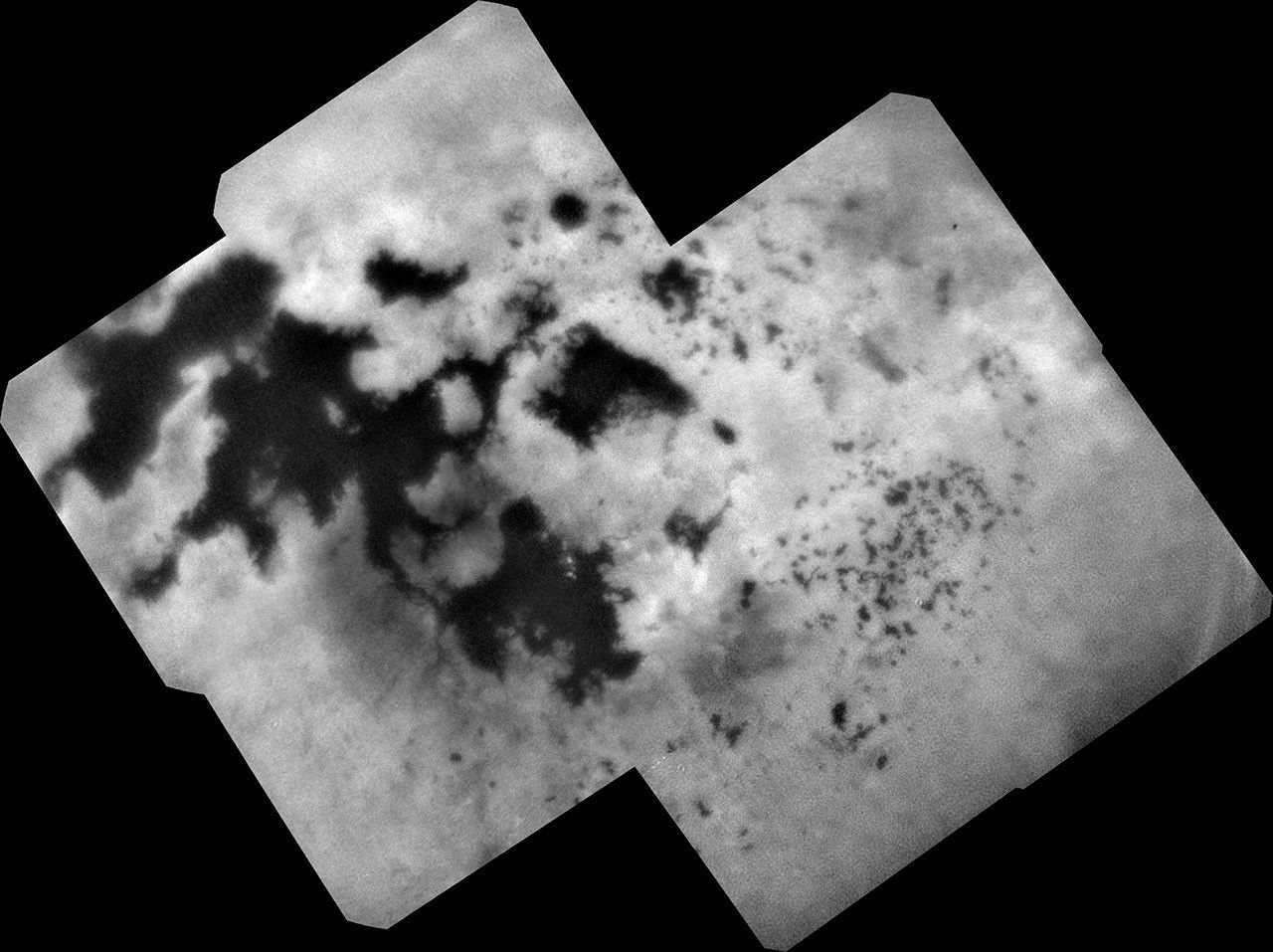
Cassini’s filtered, near-infrared mosaic of Titan’s northern lakes and seas; this is an instrument view, not a natural-color photograph. Credit: NASA/JPL-Caltech/Space Science Institute. Image record.
6. Enceladus: an ocean that sprays into space
Cassini found that Saturn’s small moon Enceladus sends water vapor, icy particles, and simple organic materials into space through fractures near its south pole, nicknamed “tiger stripes.” Measurements of the plumes and the moon’s gravity point to a global subsurface ocean beneath the ice. The jets also help feed Saturn’s E ring. This makes Enceladus unusually accessible to study: a passing spacecraft can sample material that has traveled from the moon’s interior. That is not evidence of life, but it is a rare opportunity to investigate an ocean world without drilling through its crust.
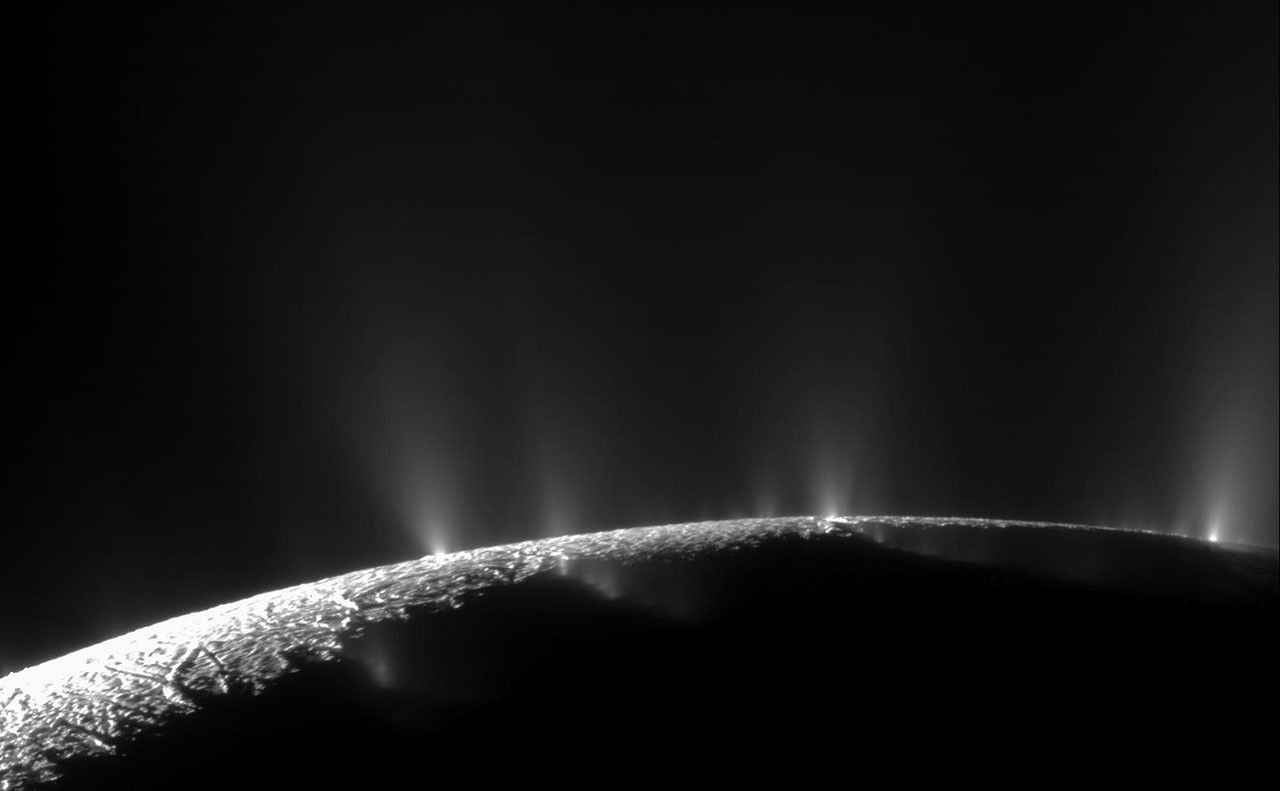
Cassini’s two-image mosaic shows plumes along four south-polar fractures; NASA notes that this presentation is rotated 180 degrees from its original orientation. Credit: NASA/JPL/Space Science Institute. Image record.
7. Hyperion: a tumbling, porous sponge of a moon
NASA’s Hyperion overview describes the irregular, heavily pitted moon and its unusual tumbling. Scientists attribute the preservation of its crisp crater shapes partly to low density and weak gravity: impact debris can escape rather than blanket nearby terrain. Cassini also detected a static charge on Hyperion’s surface, an unusual property noted in NASA’s Saturn-moons overview. Few moons combine such a strange silhouette with such unusual surface physics.
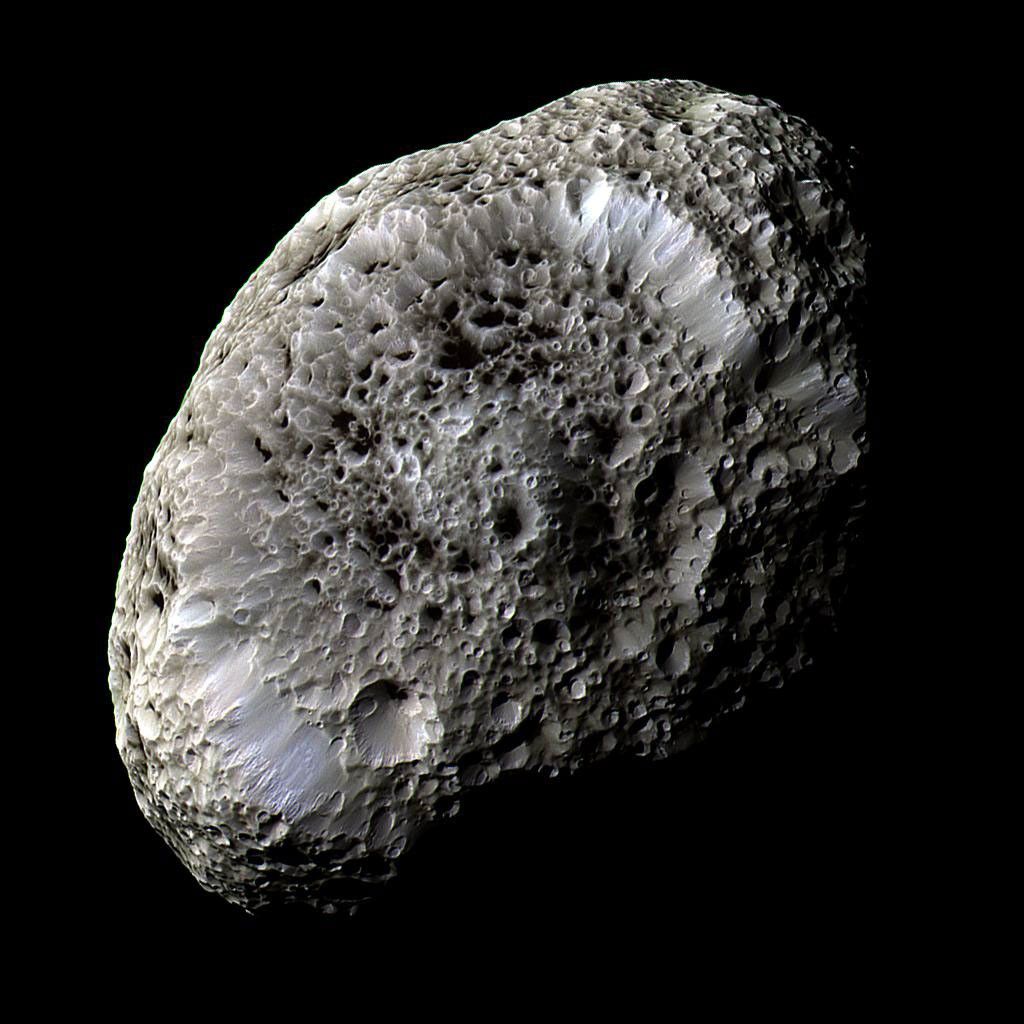
This Cassini view combines infrared, green, and ultraviolet filters; the color is enhanced false color, not what a human eye would see. Credit: NASA/JPL-Caltech/Space Science Institute. Image record.
8. Iapetus: half charcoal, half snow, with a ridge
NASA’s Iapetus overview describes a stark brightness divide: one hemisphere is dark, while the other is bright with ice. One hypothesis is that its leading side collects dark material from outside Iapetus; thermal segregation—dark material warming while ice migrates away—likely amplifies the contrast and may be the main driver. Then there is the equatorial ridge, a chain of mountains circling much of the moon and rising about 10 kilometers high. Scientists still debate how the ridge formed, so Iapetus wears both a color mystery and a geological one.
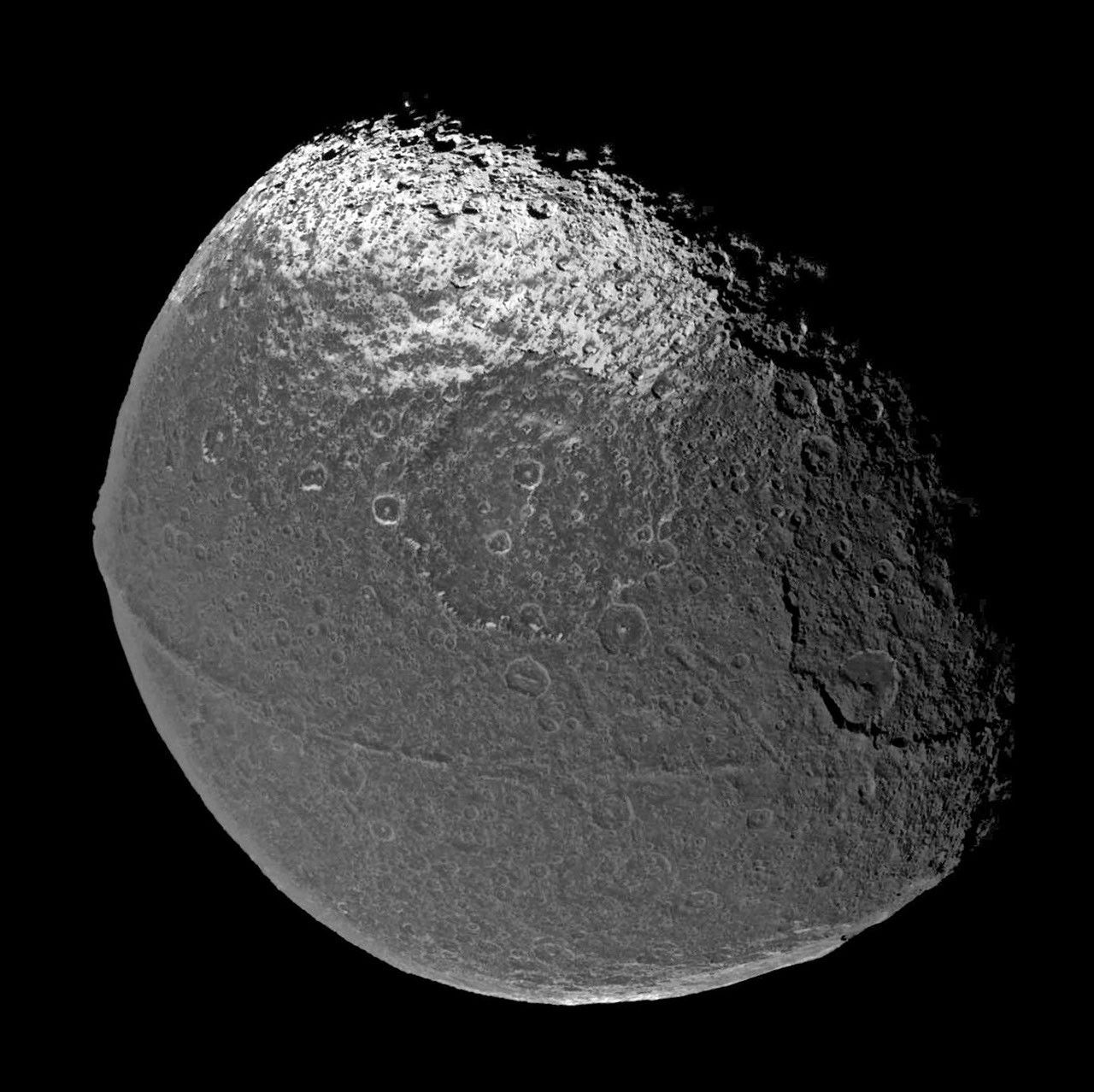
Cassini’s four-image visible-light mosaic is contrast-enhanced to reveal the two-tone surface and topography; it is not a raw single exposure. Credit: NASA/JPL/Space Science Institute. Image record.
9. Miranda: giant canyons on a small moon
NASA’s Miranda overview notes that Uranus’s Miranda is only about 500 kilometers across, yet it has one of the Solar System’s most dramatic patchwork surfaces. Its three large “coronae” are ridged, valley-cut regions sharply set off from older, more cratered ground. Miranda’s great fault canyons are described as up to 12 times as deep as the Grand Canyon. The exact processes that built these features remain uncertain; a small moon can still carry a spectacularly complicated history.
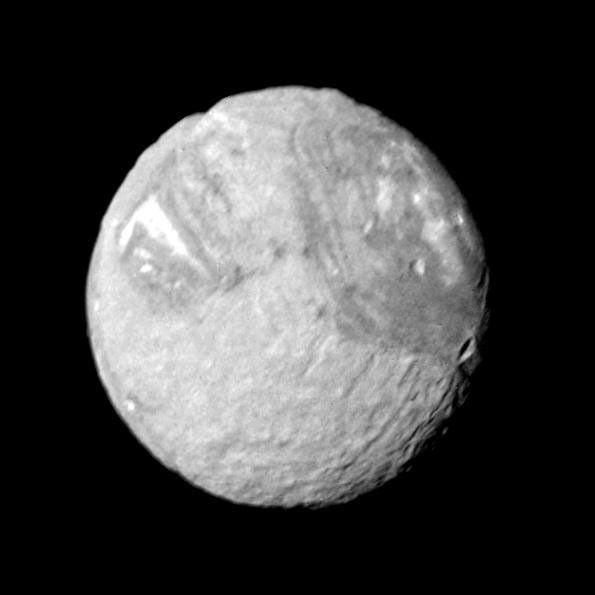
Voyager 2 images combined into an orthographic mosaic centered near Miranda’s south pole. Credit: NASA/JPL. Image record.
10. Triton: Neptune’s backwards-orbiting moon
NASA explains Triton’s orbit as retrograde: it moves opposite Neptune’s rotation. That unusual path is why scientists think Neptune captured it from the Kuiper Belt rather than forming it in place. During its 1989 flyby, Voyager 2 observed active geysers; Triton’s surface also preserves evidence of past geological activity, including smooth plains shaped by icy flows.
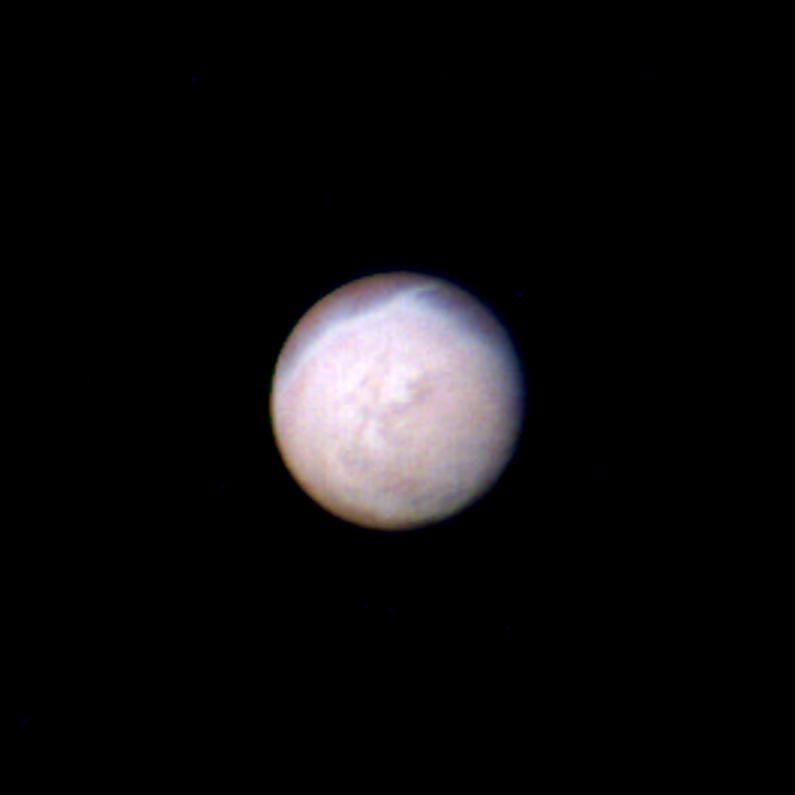
Voyager 2’s color view combines images through green, clear, and violet filters. Credit: NASA/JPL. Image record.
The list could easily continue: the Solar System’s moons include worlds with oceans, atmospheres, volcanoes, ancient craters, and surfaces that reflect their planets’ histories. The point is not that these ten are objectively “the strangest,” but that looking beyond the familiar Earth–Moon pair reveals how many different kinds of worlds can orbit a planet.