
A clock does not need a screen, a battery, or even moving hands. It needs something that changes predictably and a way to interpret that change. Across different places and periods, people found useful rhythms in shadows, flowing water, burning materials, stars, and mechanical motion.
These ten examples are a curated tour, not a ranking of the best inventions or a claim that one method simply replaced another. Some told people the time of day; others measured how long an activity lasted. That distinction helps explain why so many different timekeepers proved useful.
1. Reading a shadow with a sundial
On a sundial, a projecting pointer casts a shadow onto a marked surface. As the Sun’s apparent position changes, the shadow provides a readable indication of time. Designers used flat plates, curved bowls, and other arrangements rather than one universal layout.
NIST describes an Egyptian shadow clock that had to be turned around at noon to measure the afternoon. That detail captures the practical side of the device: using it meant understanding its orientation, not simply leaving any stick outdoors. Sunshine was part of the mechanism. Source: NIST’s history of early clocks.
2. Watching the level in a water clock
Water clocks turned a changing liquid level into a measure of elapsed time. In some designs, water drained through a small opening; in others, it entered a vessel. Marks showed how far the process had progressed. Unlike a sundial, the device could operate at night.
The difficult part was controlling the flow. More elaborate mechanisms addressed pressure and supplied displays or audible signals. This was water used as a measuring tool, rather than as a system for supplying homes or irrigating fields. Source: NIST on water clocks.
3. Letting sand run through a glass
A sandglass measures an interval as grains move between connected chambers. Its familiar shape can make it look more straightforward than it is: the quantity of sand, the opening, and the particles all matter to its performance. The Library of Congress explains these calibration factors.
Nor does every “hourglass” measure an hour. Royal Museums Greenwich holds an eighteenth-century example that currently runs for forty minutes. Its catalogue suggests an earlier restoration may have added too much sand, and that it probably originally measured thirty. The qualification matters: an old object’s present behavior may not match its original purpose. Source: the museum’s object record.
4. Measuring a candle as it burned
A candle can supply both light and a visible record of passing time. As it burns down, its remaining length can be compared with markings. The method depends on a sufficiently predictable burn, not merely on drawing lines at arbitrary intervals.
The Seiko Museum describes historical candles marked along their length for timekeeping. A useful way to understand the idea is to contrast it with a sundial: the candle consumes its own measuring material, while the sundial follows an external cycle. Eventually, the candle needs replacing. Source: Seiko Museum on combustion clocks.
5. Following the progress of burning incense
Incense offered another way to make combustion readable. The Seiko Museum describes powdered-incense timekeeping in Japanese Buddhist temples, where the length already burned indicated the passage of time. Source: Seiko Museum.
These objects could also belong to domestic and scholarly life. A Science Museum curator describes portable Chinese incense clocks and their decorative metal cases. The appeal was not limited to measurement: fragrance and craftsmanship were part of the experience. Timekeeping could therefore be something people smelled and contemplated, not only something they read from a dial. Source: Science Museum’s incense-clock study.
6. Aligning a nocturnal with the stars
A nocturnal was an instrument for reading approximate time at night. In the arrangement described by Suffolk Heritage Explorer, the user set the date and aligned pointers with the Pole Star and the two principal stars in the Great Bear. The instrument’s scales translated that alignment into a time reading. Source: Suffolk County Council’s instrument definition.
Think of it as a guided way to interpret the sky rather than a clock that keeps ticking unattended. Its dependence on visible stars also explains the practical limitation: an obscured sky removes the information the user needs.
7. Calculating astronomical times with an astrolabe
An astrolabe combined observation with calculation. Its scales and movable components could help a knowledgeable user work out astronomical information, including sunrise, sunset, and the length of the day.
Oxford’s History of Science Museum explains a sunrise calculation involving the Sun’s position, a rotating star map, and a plate representing latitude. This was not simply another sand timer. It made relationships in the sky manageable on a handheld instrument. The reward for learning its more complicated operation was a range of answers, rather than one repeating interval. Source: Oxford’s astrolabe guide.
8. Regulating a weight-driven mechanical clock
In a weight-driven clock, descending weights provide energy, while an escapement regulates the mechanism’s movement. NIST describes large mechanical clocks appearing in Italian city towers during the fourteenth century, using a verge-and-foliot regulating system.
The machinery did not automatically guarantee precision. Friction and changes in driving force affected its rate. The important distinction is between powering a clock and regulating it: having enough energy to turn wheels is not the same as making those wheels advance reliably. Source: NIST on mechanical timekeeping.
9. Counting the swings of a pendulum
Pendulum clocks used a repeating swing to regulate their mechanisms. NIST dates Christiaan Huygens’s pendulum clock to 1656 and describes the substantial accuracy improvements that followed. Later designs addressed problems such as temperature changing the pendulum’s length.
The pendulum belongs in this list separately from earlier mechanical clocks because it changed the regulator, not merely the appearance of the dial. It illustrates a recurring engineering lesson: a more dependable rhythm can matter more than a more elaborate display. Source: NIST on pendulum-clock development.
10. Carrying a precision marine timekeeper
Keeping reliable time aboard a moving ship presented a different challenge from keeping it on land. John Harrison developed several marine timekeepers while pursuing a solution to the longitude problem. His H4 resembled a large pocket watch but was a specialized precision instrument.
Royal Museums Greenwich describes both the sea trials and the long disputes surrounding recognition of his work. It also notes that wider adoption took time because marine chronometers were initially expensive. Useful invention and everyday availability were separate achievements. Source: Royal Museums Greenwich’s Harrison history.
What connects these methods is not a single march toward a screen. Each makes a different compromise between portability, precision, visibility, and the conditions around it. A timer answers “how long?” while another instrument answers “what time?” Looking at those questions separately makes the variety of historical timekeeping much easier to appreciate.
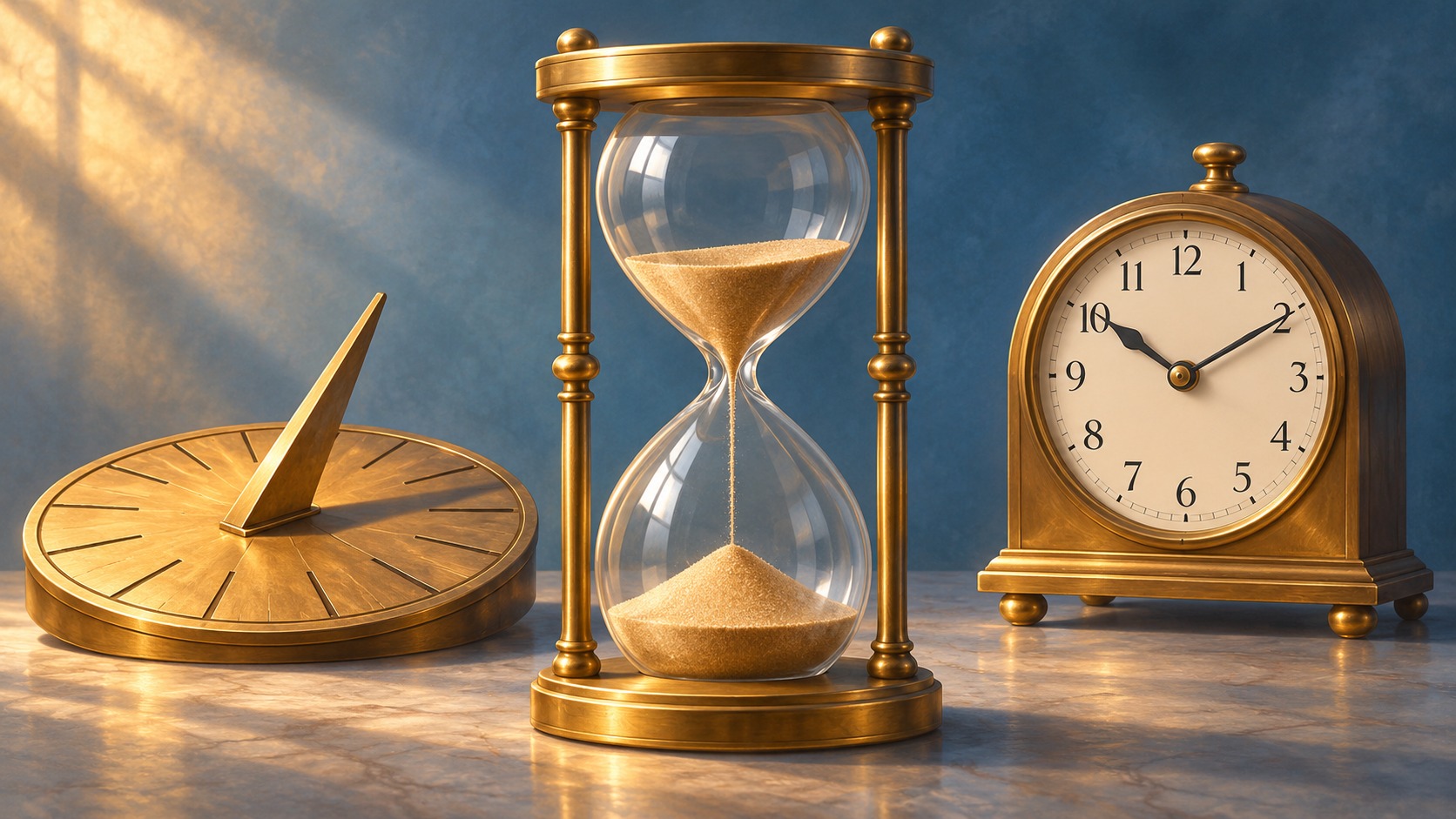
Cover: AI-generated editorial illustration, not a reconstruction of specific historical instruments.