
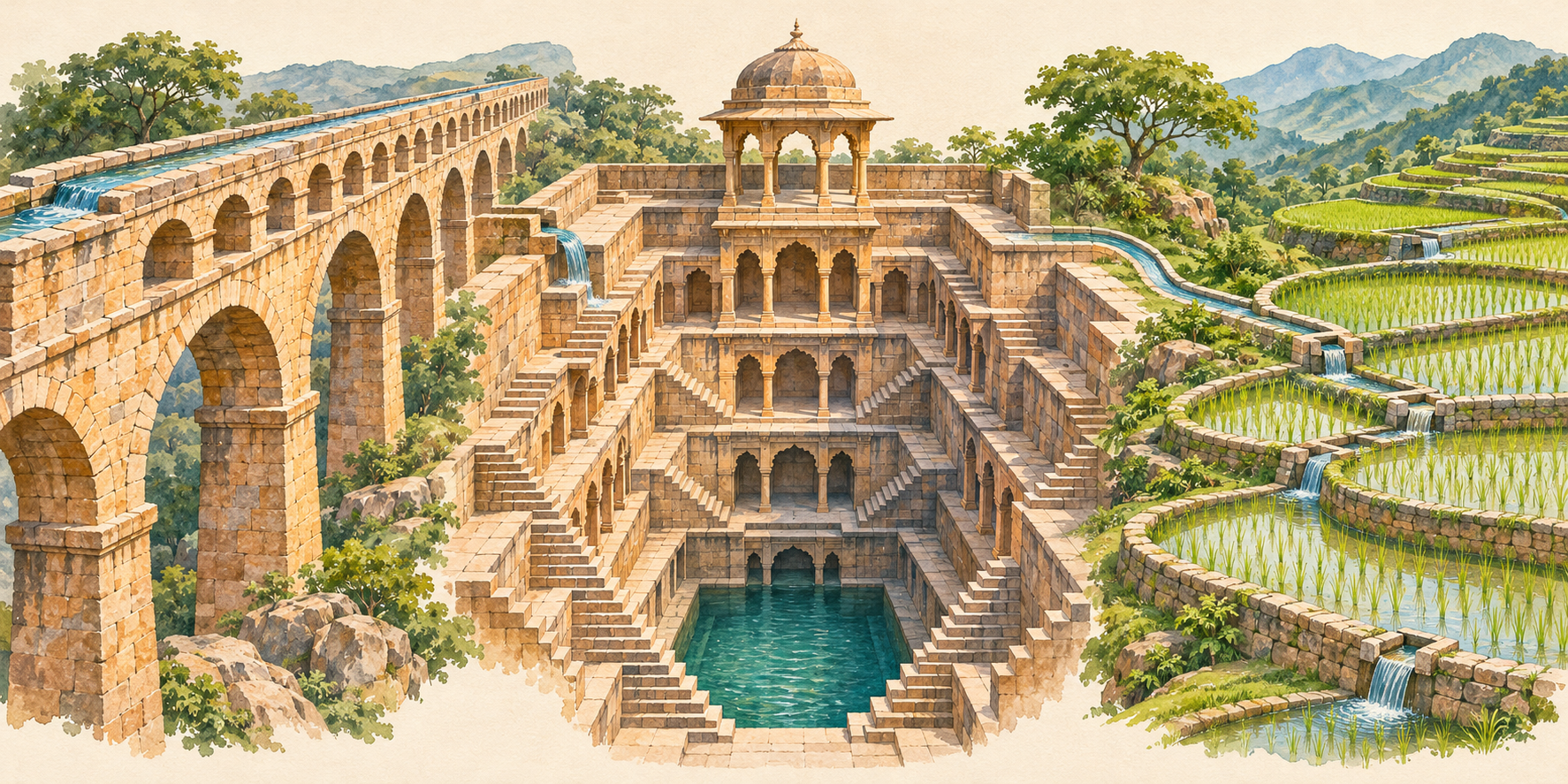
Featured image: AI-generated conceptual illustration of historic water engineering, not a reconstruction of a particular site.
Aqueducts get the dramatic skyline photographs. But a channel beneath the desert, a staircase descending to a well or a carefully organized farming community can be just as remarkable. Moving water is only part of the problem: people also have to store it, divide it and maintain the system that delivers it.
These ten historic water systems show different answers to those challenges. The countdown moves from individual structures to interconnected landscapes; it is an editorial sequence, not a ranking of which civilization was most advanced.
10. Segovia’s aqueduct: stonework without mortar
Spain | The challenge: carrying water above uneven ground.
Segovia’s Roman aqueduct uses large granite blocks fitted together without mortar. Its famous elevated section holds the water channel high above the streets, while the wider route brought water into the city. The striking part is not merely its height: the structure depends on the relationship between carefully placed stones. Seen as infrastructure rather than a monument, those arches become a solution to maintaining the channel’s route across changing ground levels. Segovia’s official account.
9. Pont du Gard: crossing a river, not just a valley
France | The challenge: keeping a water supply moving across the Gardon.
The Pont du Gard formed part of the roughly 50-kilometre aqueduct supplying Roman Nîmes. Three levels of arches carried its conduit across the river. UNESCO’s detailed account highlights an easily overlooked feature: the builders adapted the structure to sudden floods, including the shape of its piers and a wider main lower arch. The lesson is visible in the masonry: an aqueduct must survive the water beneath it while transporting different water above. UNESCO’s description.
8. Rani-ki-Vav: a well you descend into
India | The challenge: making access to water part of public architecture.
Built in the 11th century at Patan, Rani-ki-Vav combines a water-management structure with the symbolism of an inverted temple. Seven levels of stairs and sculptural panels lead downward through an elaborate subterranean space. Its corridor, pavilions, tank and well belong to one connected design. It is a useful reminder that essential infrastructure need not be visually anonymous: here, the approach to water became an architectural and religious experience. UNESCO’s inscription statement.
7. The Persian qanats: an underground route powered by gravity
Iran | The challenge: bringing groundwater to settlements.
Qanats tap aquifers and carry water along underground tunnels, sometimes for many kilometres. A line of shafts provides access and ventilation along the route. The eleven examples in the World Heritage property represent more than excavation skill: they also include reservoirs, watermills and a communal system for sharing water. Much of the engineering is hidden from view, so the small openings seen at the surface reveal only fragments of a much larger network. UNESCO’s qanat overview.
6. Oman’s aflaj: sharing water by time
Oman | The challenge: dividing a limited supply.
Aflaj systems collect water and deliver it through channels for households and agriculture. Gravity does the moving, but community organization does the allocating. UNESCO describes time-based shares, traditionally monitored using a sundial, with sluices directing water to farms at the appropriate time. The five listed systems therefore preserve two kinds of ingenuity: physical channels through difficult terrain and arrangements that make neighbors jointly responsible for their upkeep. UNESCO’s aflaj account.
5. Shushtar: one river serving many purposes
Iran | The challenge: coordinating an entire hydraulic system.
Shushtar brings together diversion canals, dams, bridges and watermills. Its functions included urban supply, irrigation, transport and defense, rather than a single isolated task. UNESCO dates the system’s overall form to the third century CE, with older foundations. Its importance lies in that combination: redirecting a river could support a city, power work and cultivate a surrounding territory. Looking at only one waterfall or bridge misses the larger engineering story. UNESCO’s historical assessment.
4. Dujiangyan: working with a river’s behavior
China | The challenge: irrigation, sediment and flood control together.
Begun in the third century BCE and enlarged across later dynasties, Dujiangyan uses the Minjiang River’s setting to distribute water to the Chengdu plains. The design addresses diversion, sediment removal and flow control together. Its long history is not a story of an untouched object: later modification is part of how the system endured. That makes it different from a ruin preserved solely for viewing; water management here remains a continuing practical activity. UNESCO’s Dujiangyan overview.
3. Angkor: the water landscape beyond the temples
Cambodia | The challenge: organizing water across an urban landscape.
Angkor’s temples can overshadow its basins, reservoirs, dykes and canals. Yet UNESCO includes those hydraulic works alongside the monuments and communication routes in its account of the site. Many reservoirs, known as barays, and canals remain identifiable. The change in perspective matters: Angkor was not simply a collection of isolated religious buildings. Its surviving waterworks help reveal the scale and organization of the cities around them. UNESCO’s Angkor description.
2. The Hani rice terraces: linking forests, villages and fields
China | The challenge: distributing water down mountain slopes.
In southern Yunnan, Hani communities developed channels that bring water from forested mountain areas to terraced rice fields. Villages occupy the space between the forests above and the terraces below. This landscape developed over roughly 1,300 years, combining water distribution with farming and enduring social practices. The terraces are beautiful, but their curves are not decoration: they belong to a working arrangement linking the upper landscape to the crops below. UNESCO’s landscape account.
1. Bali’s subak: cooperation as infrastructure
Indonesia | The challenge: coordinating irrigation across communities.
Bali’s subak system connects canals, weirs, rice terraces and water temples. The temples serve as centers of cooperative water management, tied to the Tri Hita Karana philosophy of relationships among the spiritual world, people and nature. Its engineering cannot be separated neatly from its institutions. A channel can carry water to a field, but deciding how communities share and manage that flow requires a system of people as well as structures. UNESCO’s subak overview.
What these systems have in common
The most revealing question is not simply “How did they build that?” It is “How did they keep it useful?” Across these examples, durable water infrastructure combines a response to local terrain with maintenance, adaptation and ways of sharing a resource. The spectacular structure is often only the visible part of the achievement.