
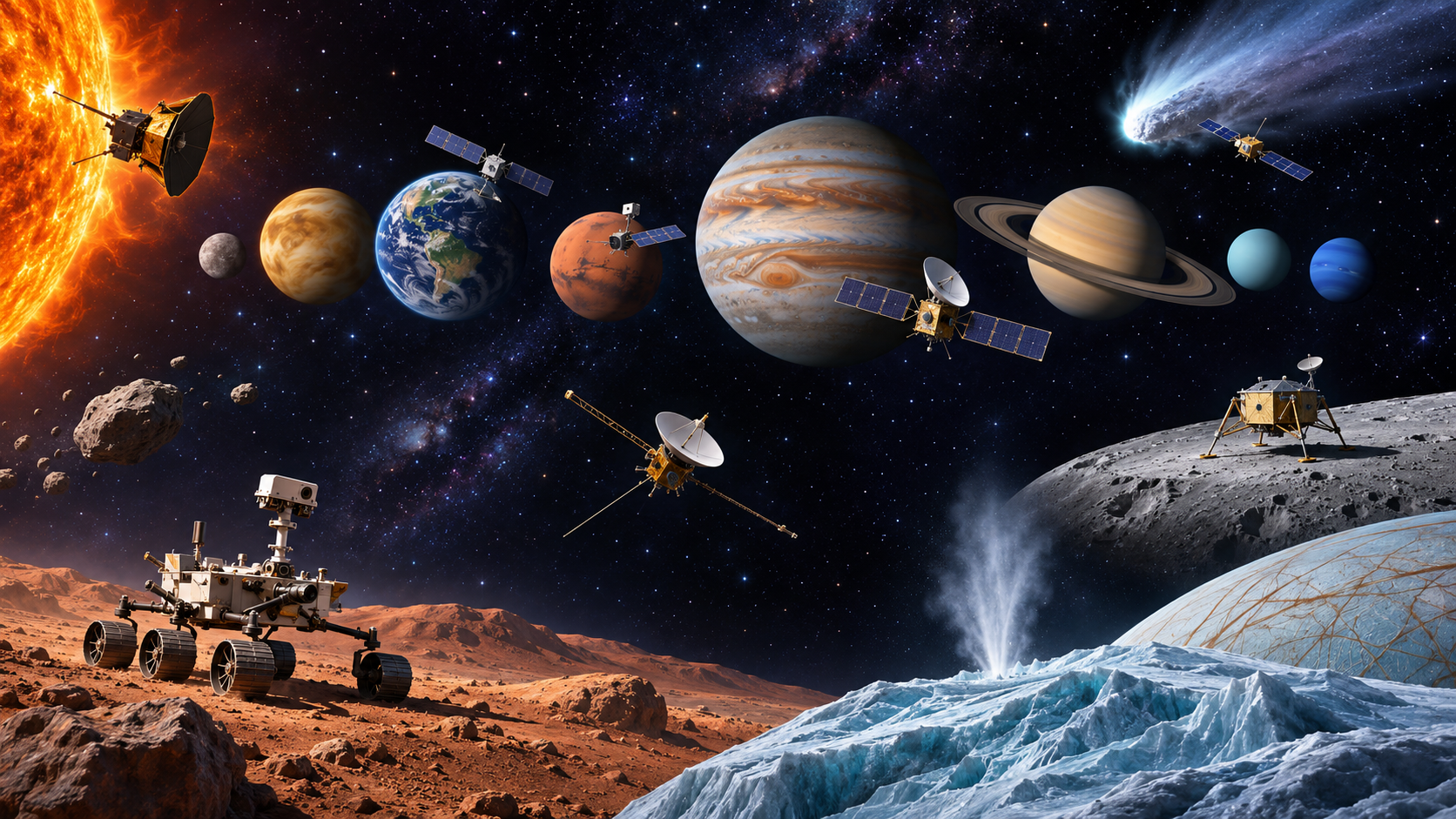
Featured image: AI-generated conceptual illustration, not to scale.
A spacecraft can change our picture of a world without bringing anything home. Sometimes the breakthrough is a photograph. Sometimes it is a measurement taken inside an atmosphere, or years spent watching a place earlier visitors could only glimpse.
These ten missions made distant destinations more understandable. They show why exploration needs different approaches: flybys for first encounters, orbiters for sustained observation, landers for a surface-level view, and instruments that measure what cameras cannot.
How we chose and ranked these missions
This is an editorial ranking, not an official scientific league table. We prioritized pioneering observations, the breadth of questions a mission helped address, and its value as an introduction to robotic exploration. The order is our judgment, not a measure of the worth of every discovery.
Our scope is robotic exploration of the Solar System and its boundary. Crewed missions and space telescopes are outside this list. The selection emphasizes NASA-led missions alongside ESA’s Rosetta; it is not a comprehensive history of worldwide space exploration.
1. Voyager 1: Carrying exploration beyond the heliosphere
Voyager 1 launched in 1977 to visit Jupiter and Saturn, then continued outward. In August 2012 it crossed into interstellar space, beyond the heliosphere, the protective region created by the Sun’s particles and magnetic field.
The same mission that investigated giant planets became a way to study a boundary no spacecraft had crossed before. That range earns it first place. NASA’s Voyager 1 overview.
2. Cassini: Spending enough time to understand Saturn
A flyby provides an encounter; an orbiter can reveal how a system changes. Cassini spent 13 years orbiting Saturn, building a richer view of the planet, its rings and surroundings than a brief passage could provide.
Its final phase took it repeatedly between Saturn and its innermost ring before entering the atmosphere in September 2017. Cassini ranks highly for showing the value of returning to a complicated subject again and again. NASA’s Grand Finale overview.
3. Mariner 4: Replacing distant impressions with close-up Mars
Mariner 4’s 1965 encounter returned the first close-up photographs of Mars. As it passed behind the planet from Earth’s viewpoint, its radio signal also traveled through the Martian atmosphere, helping scientists investigate it.
Its limited view was not a complete portrait, but it opened a new way of studying the planet. NASA’s Mariner 4 history.
4. Viking 1: Making Mars a place to investigate from the ground
Viking 1’s lander touched down on Mars on July 20, 1976, and returned surface images. The mission combined an orbiter’s wider perspective with a lander’s local observations.
On the ground, instruments investigated weather and sampled soil. Viking’s biological experiments did not establish the discovery of Martian life. NASA’s Viking 1 account.
5. New Horizons: Bringing Pluto into close view
New Horizons flew past Pluto in July 2015, giving scientists an up-close investigation of the dwarf planet and its moons. It continued to another destination, encountering the Kuiper Belt object Arrokoth in 2019.
Its second encounter extended close-range exploration farther into the outer Solar System. NASA’s New Horizons overview.
6. Rosetta: Following a comet instead of rushing past
ESA’s Rosetta arrived at comet 67P/Churyumov–Gerasimenko in 2014. Rather than collecting a brief flyby snapshot, it accompanied the comet on its journey around the Sun. It also deployed Philae, the first lander to reach a comet’s surface.
Following the same target allowed scientists to investigate a changing object over time. ESA’s Rosetta overview.
7. Galileo: Investigating Jupiter from orbit and within its atmosphere
Galileo became the first spacecraft to orbit Jupiter, enabling long-term study of the planet and its surroundings. It carried a descent probe that measured the giant planet’s atmosphere directly.
The orbiter could revisit targets while the probe gathered information during descent. Those complementary approaches earn Galileo its place. NASA’s Galileo overview.
8. Magellan: Mapping Venus with radar
Magellan used radar to investigate the surface of Venus. Across successive mapping cycles, its coverage expanded to 98 percent of the planet.
Its maps provided a broad foundation for studying Venusian terrain and show why planetary exploration cannot rely on ordinary photographs alone. NASA’s Magellan history.
9. MESSENGER: Turning Mercury into a sustained research destination
MESSENGER became the first spacecraft to orbit Mercury. Its mission examined the planet’s geology, magnetic field and chemical composition.
Its long route included gravity-assist encounters. Getting closer to the Sun did not mean the journey was a simple straight-line fall; reaching a planet and slowing down enough to stay there are different challenges. NASA’s MESSENGER overview.
10. Dawn: Comparing two worlds in the asteroid belt
Dawn made extended visits to Vesta and Ceres, two different bodies in the main asteroid belt between Mars and Jupiter. Studying both with one mission gave scientists a valuable comparison.
Dawn widens the list beyond the major planets. Smaller bodies are part of the Solar System’s story, and visiting more than one helps reveal their differences. NASA’s Dawn overview.
What these missions have in common
The common achievement is not distance, speed or an impressive launch. Each mission found a useful way to replace uncertainty with observations. Mariner 4 showed the power of a first close look. Cassini and Rosetta showed the value of staying. Viking and Galileo added measurements requiring a closer approach. Magellan demonstrated that the right instrument can matter as much as the destination.
Robotic exploration gives us more than pictures to admire. It gives us evidence to work with.