
A passenger aircraft can be extraordinarily long without being a double-decker—or even a widebody. The longest airline families include modern twinjets, four-engine giants and two retired supersonic designs. This historical ranking measures the aircraft from nose to tail, not its wingspan, seat count or flight range.
How we chose: each family appears once, represented by its longest version that entered airline passenger service. Retired aircraft qualify; freighter-only, military-only and test aircraft do not. Most figures are rounded to one decimal metre from manufacturer or operator specifications. The Tu-144 has a clearly disclosed range of reported source figures rather than a falsely precise reconciled number. An MD-11 engine-installation difference also matters near the bottom of the list.
| Rank | Family and passenger version | Published length used |
|---|---|---|
| 1 | Boeing 747 — 747-8 Intercontinental | 76.3 m |
| 2 | Airbus A340 — A340-600 | 75.4 m |
| 3 | Boeing 777 — 777-300ER / 777-300 | 73.9 m |
| 4 | Airbus A350 — A350-1000 | 73.8 m |
| 5 | Airbus A380 — A380-800 | 72.7 m |
| 6 | Boeing 787 — 787-10 | 68.3 m |
| 7 | Tupolev Tu-144 — passenger-service production aircraft | 64.5–67.1 m* |
| 8 | Airbus A330 — A330-300 / A330-900 | 63.7 m |
| 9 | Concorde — airline production aircraft | 62.1 m† |
| 10 | McDonnell Douglas MD-11 — GE-powered passenger model | 61.6 m |
* Published Tu-144 lengths are not directly comparable; their measurement convention remains unresolved here. See entry 7. The range is not a claim that one aircraft changes length by 2.6 metres in operation. † Concorde uses British Airways’ published specification. This is a family ranking, not a list that counts every stretched variant separately.
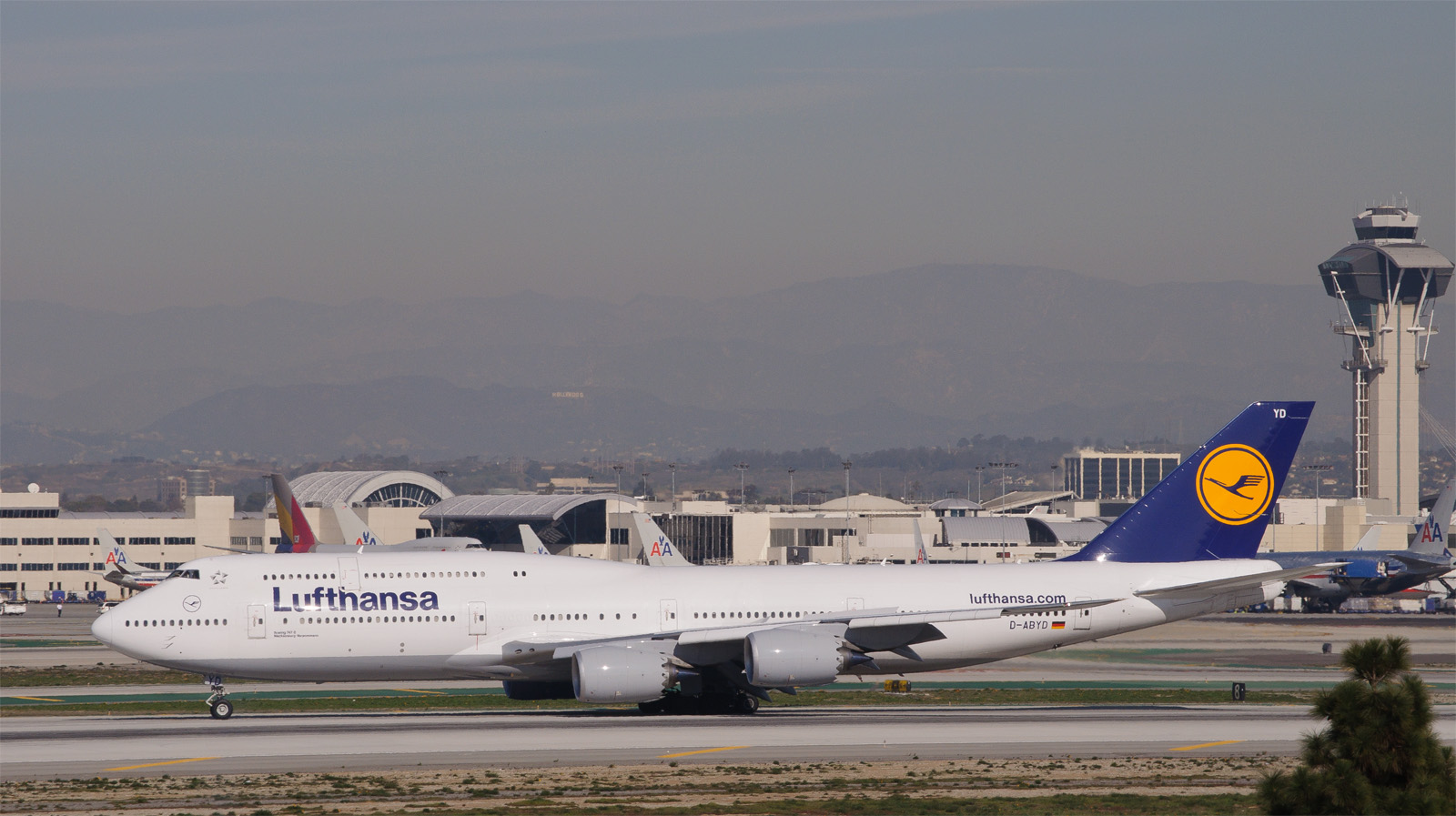

1. Boeing 747-8 Intercontinental — 76.3 metres
The passenger 747-8 takes first place under the airline-service rule. Boeing’s Intercontinental overview gives a 76.3-metre overall length. Its drawings also show how the main deck continues beneath a shorter upper deck: the famous hump is not a second full-length passenger floor.
This is specifically the Intercontinental, not the 747-8 Freighter. The final passenger stretch also makes “Boeing 747” too vague for a length comparison: earlier family members were shorter. Counting each of those variants as a separate entry would make a very different list, dominated by repeated aircraft names.
2. Airbus A340-600 — 75.4 metres
The A340-600 is the long-fuselage member of Airbus’s four-engine A340 family. Its airport-planning dimensions specify 75.36 metres, rounded here to 75.4. Airbus’s 2002 annual review records its arrival in Virgin Atlantic service that August.
The -600 illustrates an earlier approach to long-haul growth: a very long single-level passenger cabin with four engines. It is longer than the A380, yet lacks the A380’s full upper passenger deck. Historical inclusion does not depend on whether a particular airline still flies it today; this is not a current route or booking guide.
3. Boeing 777-300ER — 73.9 metres
Boeing’s 777 specifications put the -300ER at 73.9 metres. The original -300 has the same nominal length, so the two share one place rather than occupying separate ranks. “ER” identifies the extended-range version; it does not mean the aircraft is longer than the original -300.
This twin-engine widebody marks a clear contrast with the four-engine aircraft above it. It also shows why the suffix matters: the shorter 777-200 variants cannot stand in for the -300ER in a length table. The 777-9 is handled separately below because a flying test aircraft is not yet an airline-service entry.
4. Airbus A350-1000 — 73.8 metres
The A350-1000 is the longer passenger version of the A350 family. Airbus currently lists 73.78 metres, which becomes 73.8 at our displayed precision. It sits just behind the 777-300ER, not in an entirely different size class.
Airbus’s first-delivery announcement describes a seven-metre stretch over the A350-900 and a six-wheel main landing-gear arrangement. Those details distinguish the -1000 from its sibling more usefully than a generic “large Airbus” label. Qatar Airways received the first example in February 2018.
5. Airbus A380-800 — 72.7 metres
The A380 is not the longest aircraft in this ranking. Airbus’s technical facts put its overall length at 72.7 metres. Its defining difference is vertical: two full passenger decks, rather than one long main cabin or the 747’s shorter upper deck.
Airbus records entry into service with Singapore Airlines on October 25, 2007. Its reputation as the largest passenger airliner therefore does not contradict fifth place here. “Largest” can refer to passenger accommodation; “longest” is only one external dimension. Comparing the two labels without stating a measurement creates the apparent contradiction.
6. Boeing 787-10 — 68.3 metres
The 787 family table is a particularly clear demonstration of why a family needs a named representative. Boeing lists the 787-8 at 56.7 metres, the -9 at 62.8 and the -10 at 68.3. The longest Dreamliner is therefore 5.5 metres longer than the -9 using those rounded figures.
The -10 remains a twin-engine, single-main-deck passenger aircraft; the extra length is not a second floor. Nor does “longest” automatically mean “longest-range”: Boeing lists different ranges for the three variants. This ranking deliberately keeps physical length separate from how far a model can fly.
7. Tupolev Tu-144 — published measurements of 64.5–67.1 metres
The Tu-144 belongs in an airline-history list, not just a catalogue of prototypes. A firsthand account by its development team identifies aircraft 77109 and 77110 in passenger operations and dates the first Moscow–Alma-Ata passenger flight to November 1, 1977. We do not substitute the later Tu-144LL research conversion for those aircraft.
Its length needs an unusually explicit caveat. The team’s production-aircraft geometry table gives 64.45 metres and a separate 67.05-metre figure; a museum heritage catalogue also lists 67.05 metres. The sources’ exact measurement convention remains unresolved here. We show the rounded range of reported figures instead of pretending to reconcile it: either endpoint leaves the Tu-144 below the 787-10 and above the A330, so seventh place is unchanged.
8. Airbus A330-300 / A330-900 — 63.7 metres
The A330-300 and newer A330-900 both round to 63.7 metres. Airbus’s current product pages give slightly different centimetre-level figures, but that is not a useful basis for calling them meaningfully different lengths here.
The -900 belongs to the A330neo generation, while the -300 represents the earlier generation. Their shared position shows that a newer model name need not mean a much longer airframe. We group them at the displayed precision and count the A330 family only once; shorter A330 variants do not receive extra places.
9. Concorde — 62.1 metres in British Airways’ specification
British Airways lists Concorde at 62.1 metres long, with a fuselage only 2.9 metres wide and seating for 100 passengers. It operated the aircraft in passenger service from 1976 to 2003. Those proportions are a useful antidote to the assumption that every long passenger plane must be a huge-capacity widebody.
Concorde’s slender shape places a retired supersonic airliner among much broader subsonic jets. We use the operator’s published reference length, not an in-flight thermal-expansion estimate. The point of this entry is historical comparison, not a suggestion that Concorde remains bookable or that its cabin offered the capacity of today’s largest aircraft.
10. McDonnell Douglas MD-11 with GE engines — 61.6 metres
The MD-11 produces the ranking’s most easily missed technical detail. Boeing’s MD-11 planning drawing gives an overall length of 61.6 metres with CF6-80C2D1F engines, but 61.2 metres with PW4460 engines. The tail-mounted engine installation changes the aircraft’s overall extent; this is not an extra stretch of the passenger cabin.
Using the longest passenger installation puts the three-engine MD-11 ahead of the approximately 61.4-metre 767-400ER. A list that copies the shorter MD-11 figure can reverse that result. As elsewhere, the passenger-service version is what qualifies the family—not the existence of freighters wearing the same model name.
Why the Boeing 777-9 is not ranked
The 777-9 has flown, so it is not an unbuilt concept. But Boeing’s third-quarter 2026 results say certification flight testing continues and first delivery is expected in 2027. Under this article’s airline-passenger-service rule, that keeps it outside the ranking as checked on November 2, 2026. A future service entry would require the list to be reviewed.
Bottom line: the 747-8 Intercontinental leads this historical family comparison. The A380’s two decks, Concorde’s narrow fuselage and the MD-11’s engine-dependent dimension explain why “biggest plane” lists can disagree unless they define exactly what they measure.