
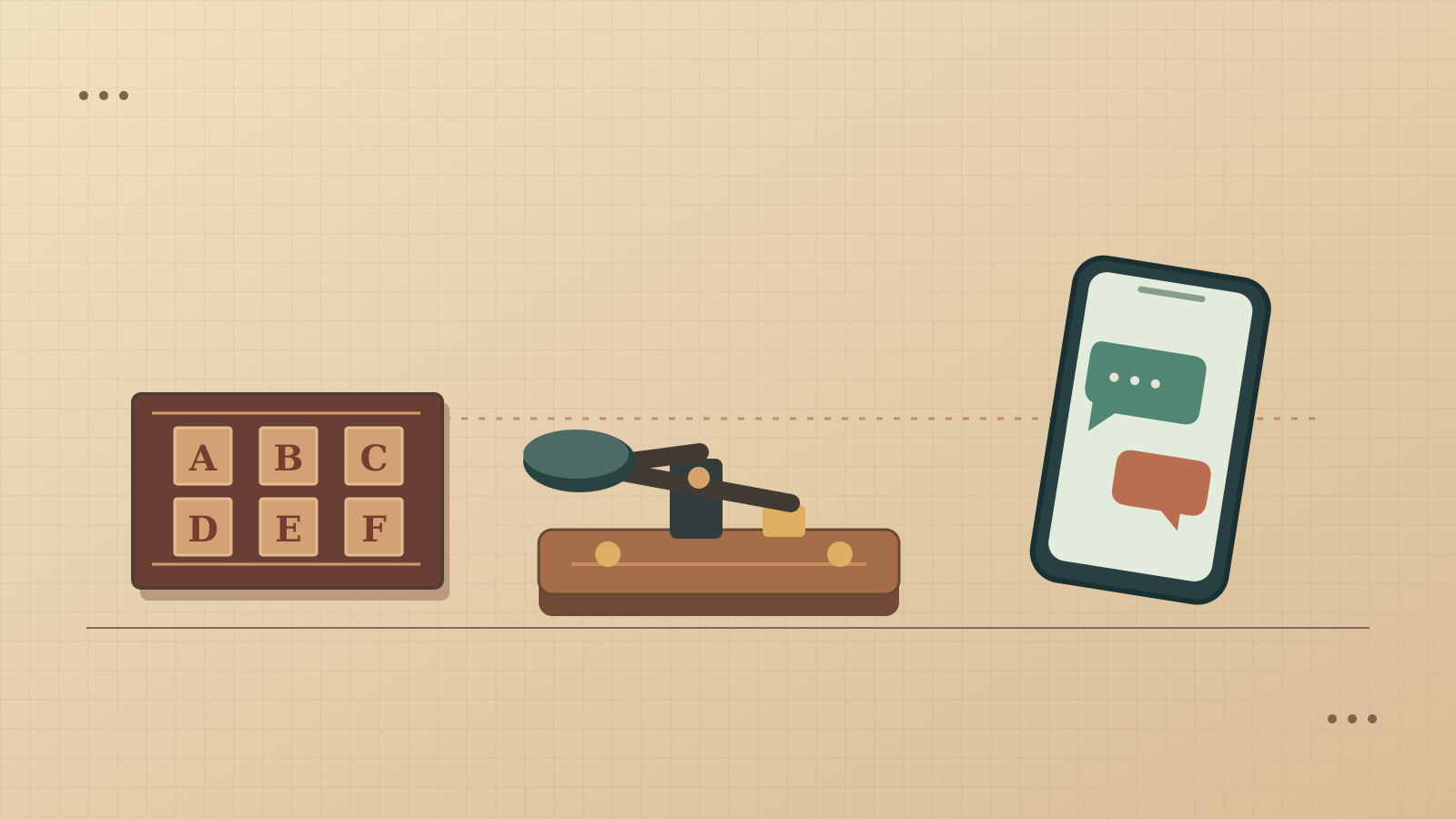
A message can cross an ocean in seconds, survive its speaker for a century, or be read through fingertips instead of eyes. Those are different achievements, and no single invention made them all possible.
These ten communication breakthroughs changed how people copy, send, receive, or preserve information. This is a roughly chronological selection, not a ranking of inventors or a claim that each technology appeared fully formed on one date.
1. Movable-type printing: making another copy without writing another book
Movable type lets printers arrange reusable characters into a page, print copies, then rearrange the characters for another text. The key is separating the reusable pieces from the particular message.
Its history did not begin with Gutenberg. The Library of Congress describes Bi Sheng’s earthenware type in eleventh-century China and earlier Asian printing traditions. Gutenberg’s mid-fifteenth-century work brought a highly influential system of metal-type printing to Western Europe. Library of Congress: Asian printing and Gutenberg Bible exhibition.
What changed: Once a page was prepared, producing additional copies no longer meant copying every word by hand. Setting up the page still required skilled work.
2. Braille: designing writing for touch
Some earlier reading systems for blind people used raised versions of printed letters. Louis Braille pursued a compact pattern of dots suited to the fingertip. His six-dot cell simplified a larger system known as night writing.
Braille can represent language, mathematics and music; refreshable displays extend the same tactile principle into digital life. It is a writing system, not a separate spoken language. Library of Congress: About Braille.
What changed: Access improved by redesigning the interface rather than expecting every reader to use a system designed for sight.
3. The electric telegraph: sending a message ahead of its messenger
A letter carried by a person has to travel physically. Electric telegraphy instead represented a message through signals along a wire. In Morse-style systems, patterns of short and long signals stood for letters and numbers.
Samuel Morse’s Washington-to-Baltimore demonstration on May 24, 1844, is a famous milestone, not the beginning of every telegraph tradition. The Library of Congress also identifies work by William Fothergill Cooke and Charles Wheatstone, and Alfred Vail’s collaboration with Morse. Library of Congress: Inventions and Innovations.
What changed: Information could move without transporting the original paper. But a functioning line, power and people able to interpret messages were still needed.
4. The telephone: keeping the voice inside the message
The telephone made a different promise: send speech rather than a code someone must translate. On March 10, 1876, Alexander Graham Bell recorded a successful experiment in which Thomas Watson understood his spoken request from another room.
Bell’s surviving letter to his father notes that some sentences worked while other speech remained difficult to understand. It documents a breakthrough in progress, not a finished worldwide service. Library of Congress: Bell’s experiment and Bell’s letter and transcript.
What changed: People could exchange questions and answers while hearing tone and hesitation.
5. The phonograph: letting a voice outlast the moment
A telephone carries sound to another place. A recording carries it to another time. Edison’s 1877 phonograph could record sound and reproduce it.
Édouard-Léon Scott de Martinville had already made sound recordings with his phonautograph in 1857. The National Park Service distinguishes those records of vibrations from Edison’s machine, which also played its recordings back. National Park Service: Origins of Sound Recording.
What changed: A listener no longer had to be present when words were spoken. Recording introduced replay and preservation, although early media were fragile.
6. Broadcast radio: one programme, many listening rooms
A broadcaster could transmit a programme that many receivers could pick up at once. The BBC’s daily broadcasts from London’s 2LO began on November 14, 1922. Its first newsreader, Arthur Burrows, read the news at two speeds and invited listeners to say which they preferred. It was a BBC milestone, not the invention of radio itself. National Science and Media Museum: BBC daily broadcasts.
What changed: Distant audiences could listen together. Unlike a telephone conversation, ordinary broadcast reception did not provide a direct reply channel.
7. Xerographic copying: sharing the page you already have
Printing makes many copies from a prepared design. An office copier solves a different problem: someone hands you a page, and you need another copy without retyping it.
Chester Carlson produced the first xerographic image in 1938. Turning that experiment into a practical product took years; the Xerox 914 arrived in 1959. Xerox: The Story of Xerography.
What changed: A document’s layout, handwriting and diagrams could travel with its words. Sharing did not have to begin with reconstructing the original.
8. Networked email: leaving a message beyond one computer
Electronic messaging existed on shared computer systems before networked email. The expansion was allowing messages to reach users on other connected machines. In the early 1970s, Ray Tomlinson used the @ sign in his ARPANET email addressing scheme. Computer History Museum: 1971 timeline.
What changed: A written exchange could cross a computer network without requiring both people to be available at the same moment.
9. The World Wide Web: making documents connect to documents
Email sends a message to an address. The Web lets a reader follow links between resources. Tim Berners-Lee invented it at CERN in 1989 to help researchers share information.
The Web is not another name for the internet: it is a system that uses the underlying network. On April 30, 1993, CERN put the Web software into the public domain; a later release used an open licence. CERN: The birth of the Web.
What changed: A document could become a doorway to another document. Readers could follow references rather than rely only on what one author had copied into a single page.
10. SMS: making a short written message mobile
The first SMS was sent on December 3, 1992, by Neil Papworth to Richard Jarvis over Vodafone’s network. It contained a Christmas greeting. Papworth sent it from a computer, not from another mobile phone. Vodafone: The first SMS.
What changed: A small message could reach a mobile handset without turning into a live voice conversation. Today’s internet-based messaging apps use different systems and support a broader range of media.
The real story is not just faster messages
Printing and copying multiplied pages. Braille changed who could read and write them. Telegraphy and telephony crossed distance. Recording crossed time. Radio gathered audiences, while email, the Web and SMS offered different ways to address people and connect information. Speed matters, but so does whether a message is easier to access, preserve, or answer.